
|
Getting your Trinity Audio player ready...
|
Dog Health & Wellness
Why Your Dog’s Sleep
Is a Family Health Issue
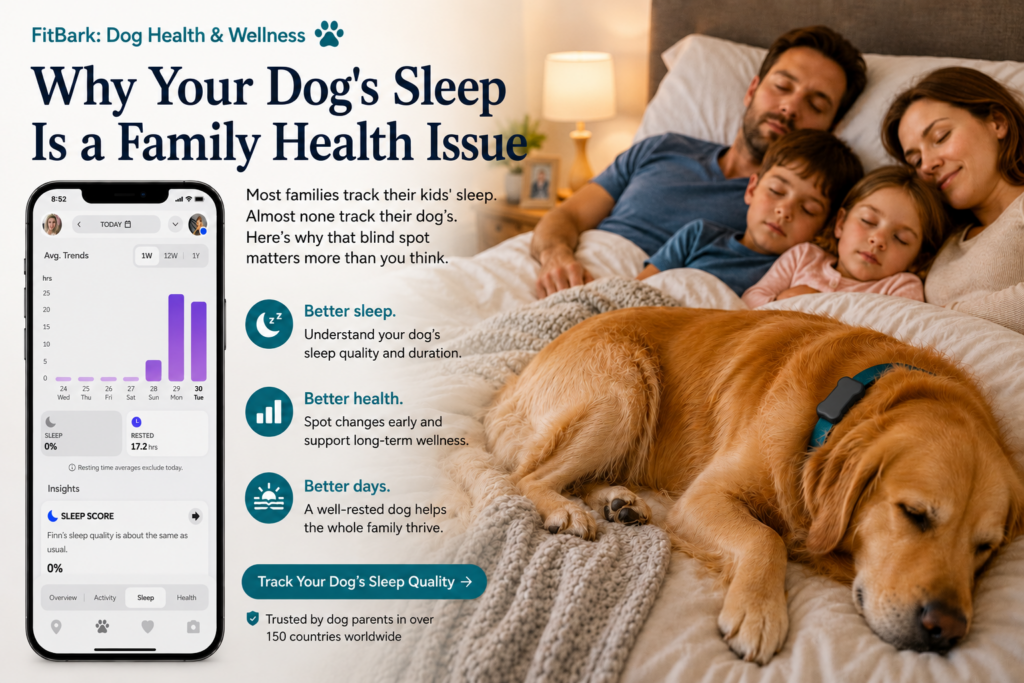
Most families track their kids’ sleep. Almost none track their dog’s. Here’s why that blind spot matters more than you think.
We are scrupulous about our kids’ sleep. We protect bedtime routines, limit screens after dinner, worry about sleep regressions, and consult pediatricians about anything that seems off. We understand, intuitively, that a poorly rested child is a different child — emotionally dysregulated, harder to reach, physically vulnerable.
And then we give almost no thought to whether our dog is sleeping well.
This is a bigger oversight than it might seem. Because just like with children, a dog’s sleep quality is one of the most reliable windows into their overall health. And a dog who isn’t sleeping well isn’t just tired — they’re showing you something you need to pay attention to.
12–14 hrs
The average adult dog’s daily sleep requirement. Puppies and senior dogs need significantly more — up to 18–20 hours. Sleep deprivation in dogs has emotional, cognitive, and behavioural consequences similar to those seen in sleep-deprived humans.
Source: Sleep Characteristics in Dogs, NIH/PubMed research literature
What Poor Dog Sleep Actually Looks Like
Most families assume their dog sleeps fine because they see the dog lying down a lot. But there’s a significant difference between resting and sleeping well. Signs that your dog’s sleep quality may be poor include:
🌙
Restlessness at Night
Frequent repositioning, pacing, or waking during the night when the household is quiet — distinct from normal dreaming movement.
😴
Daytime Exhaustion Despite Sleeping
A dog who sleeps for long periods but still seems lethargic and unengaged during waking hours may not be reaching restorative sleep stages.
😰
Whining or Panting at Night
Night-time vocalisation and panting without obvious cause — no heat, no need to go outside — can indicate anxiety, pain, or cognitive dysfunction.
🐕
Behavioural Changes During the Day
Irritability, reduced play drive, reactivity, or unusual clinginess during the day often trace back to disrupted nighttime sleep.
The Connection to Your Family’s Sleep
Here’s something families rarely connect: a dog who sleeps poorly often disrupts the whole household’s sleep. Research on co-sleeping and pets — even when the dog sleeps in another room — shows that a restless dog creates noise and movement patterns that subtly fragment human sleep cycles, particularly for lighter sleepers and children.
A 2021 study in the Sleep Health Journal found that children who reported co-sleeping with pets generally didn’t experience worse objectively measured sleep — but the quality was highly variable, and depended significantly on the dog’s own sleep quality and temperament. In other words: a calm, well-rested dog tends to support calm sleep in the children nearby. A restless, anxious dog does the opposite.
“Poor sleep in dogs may exacerbate protective emotional states, leading to a cycling of worsening sleep and more extreme behavioural reactions.”
— Sleep Characteristics in Dogs; Effect on Caregiver-Reported Problem Behaviours, NIH
The Most Common Causes of Poor Dog Sleep
Insufficient exercise. This is the most common cause by far, especially in high-energy breeds. A dog who hasn’t expended their physical and mental energy during the day will not settle properly at night. Think of it like a child who didn’t run around enough at recess.
Anxiety. Separation anxiety, noise sensitivity, changes in routine (a new school year, a parent travelling, a new baby) — all of these can significantly disrupt a dog’s sleep patterns. Dogs are exquisitely sensitive to household emotional atmosphere.
Pain or discomfort. Dogs don’t communicate pain the way we do. Sleep disruption — particularly restlessness, frequent position changes, or reluctance to lie down in their usual spot — is one of the most consistent early indicators of physical discomfort, especially in aging dogs.
Cognitive dysfunction. In older dogs, what looks like nighttime restlessness or confusion is sometimes canine cognitive dysfunction syndrome — the dog equivalent of dementia. It’s underdiagnosed precisely because families often attribute it to “just getting old.” Early intervention makes a real difference.
What You Can Do
The practical steps are largely the same ones that support good sleep in children: consistent routine, sufficient daytime activity, a safe and comfortable sleep environment, and close attention to changes over time.
That last point — attention to changes over time — is where most families struggle. We notice dramatic changes. We miss gradual ones. A dog who is sleeping slightly worse each week over two months will look “fine” in any given snapshot, but the trend is meaningful. Tracking changes over time is genuinely the most important thing you can do for your dog’s long-term health.
The Takeaway
Your dog’s sleep is not a minor footnote in their health story. It’s one of the central chapters. A dog who sleeps well is more emotionally balanced, more physically healthy, more engaged and playful with your children, and far more likely to be the thriving family companion you imagined when you brought them home.
Pay attention to your dog’s sleep the way you pay attention to your kids’. The signals are there. You just have to learn to read them.
Sources & Further Reading
- Sleep Characteristics in Dogs; Effect on Caregiver-Reported Problem Behaviours. NIH/PubMed. ncbi.nlm.nih.gov
- The curious incident of the dog in the nighttime: Effects of pet-human co-sleeping on children’s sleep. Sleep Health Journal, 2021. sleephealthjournal.org
- Baranyai, L., et al. (2025). Family Dogs’ Sleep Macrostructure Reflects Worsened Sleep Quality When Sleeping in the Absence of Their Owners. Animals, 15(21).
- PetMD. 4 Most Common Sleep Disorders in Dogs. petmd.com