
|
Getting your Trinity Audio player ready...
|
What Your Dog Is Teaching Your Kids
Without You Even Realizing It
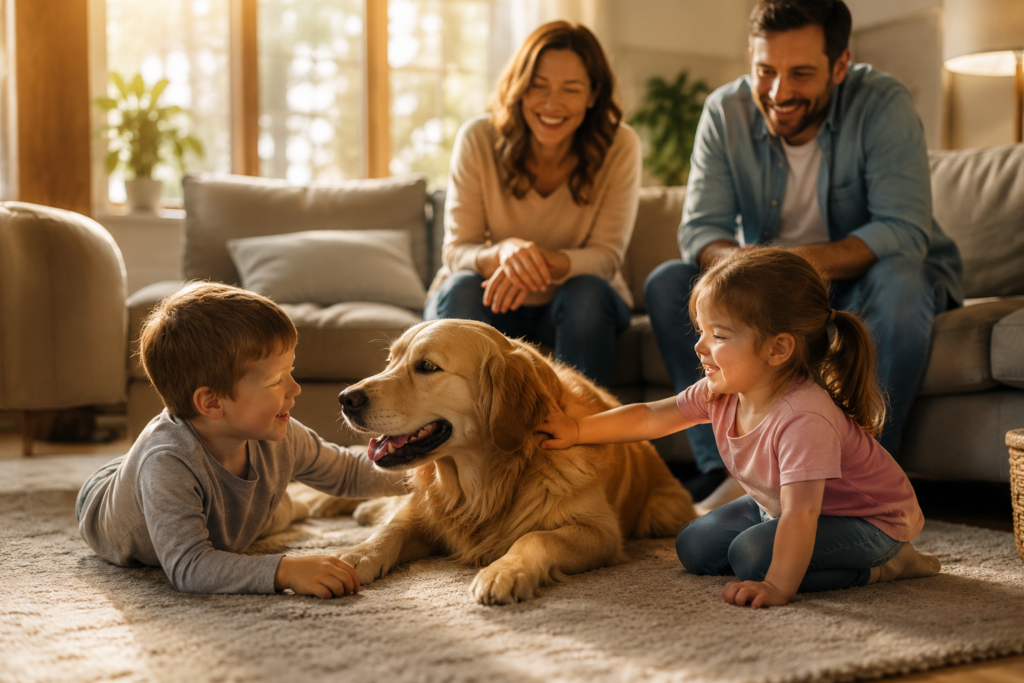
The most important lessons your children are learning right now aren’t happening in a classroom. They’re happening on the living room floor. Your child growing up with a dog, and that has emotional and developmental benefits. Discover the benefits of having a dog with kids.
There’s a moment that happens in almost every family with a dog and young kids. The dog does something — nudges a crying child, waits patiently at the door, senses something is off before the adults do — and everyone in the room goes quiet for just a second. Something real just happened. Something that no worksheet or structured lesson could have manufactured.
What most parents don’t realize is that those moments are happening constantly. Every single day your dog is alive in your home, they are teaching your children things that will follow them into adulthood. The lessons are quiet, unscripted, and remarkably powerful.
Here are the seven most significant ones — backed by research and recognized by child development experts. Eighty-seven perscent of pet owners report that their companion animal has had a meaningful positive impact on their family’s emotional wellbeing, according to the Human-Animal Bond Research Institute.
Source: Human-Animal Bond Research Institute (HABRI), National Survey
The 7 Lessons Your Dog Teaches Every Day
Empathy — Reading Someone Who Can’t Use Words
Dogs communicate entirely through body language, tone, and energy. Children who grow up with dogs become remarkably skilled at reading non-verbal cues — not just in animals, but in other people. Research from the University of West of Scotland found that children with strong pet attachments showed better interpretation of animal behaviour and facial expressions, and were measurably more compassionate toward others. Your child learns to notice when someone needs space, comfort, or reassurance — because the dog taught them to pay attention. The family dog helps children develop empathy.
Consistency — The World Rewards Showing Up
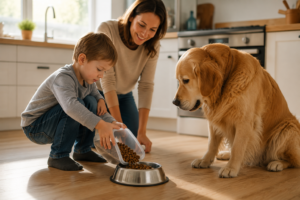
The dog needs to be fed. Every day.
Consistency is important for dogs and child development. Whether your child feels like it or not. This is one of the most underrated lessons in childhood: that living things depend on us, and that dependency is not negotiable. Studies on children and pet care routines consistently show that kids who participate in regular pet care develop stronger self-regulation and a greater sense of personal accountability than those without such responsibilities.
Unconditional Acceptance — Being Loved Exactly as You Are
Dogs don’t care if your child struck out at baseball, bombed a spelling test, or said something unkind at school. They’re at the door, tail going, the second your kid walks in. That non-judgmental presence is not trivial — it’s psychologically profound. Research published in Anthrozoös found that children who perceived strong emotional bonds with their pets had higher self-esteem and were more willing to attempt challenging tasks, because they had a reliable source of unconditional acceptance to return to.
Grief — That Love and Loss Are Inseparable
This is one parents often dread, but child psychologists tend to view it differently. The eventual loss of a family dog is frequently a child’s first experience with grief. Handled with honesty and compassion, it becomes one of the most important emotional lessons of childhood — that grief is not a weakness, that it’s the cost of love, and that it can be survived. Children’s Hospital Colorado notes that pet loss, when navigated well by parents, can prepare children for future losses in ways that abstract conversations simply cannot.
Patience — Some Things Can’t Be Rushed
Training a dog teaches patience in its purest form. You cannot force a dog to sit on command after two tries. You cannot rush trust. Kids who help train family dogs — even in small ways — internalize something many adults struggle with: that meaningful results take time, repetition, and calm persistence. The dog never rewards frustration. It rewards patience every single time.
Boundaries — Consent Is Something Everyone Deserves
Teaching a child that the dog doesn’t want to be hugged right now, or that we don’t startle a sleeping dog, or that we let the dog come to us rather than chasing it — these are early, concrete lessons in consent and bodily autonomy. The child learns that even those who can’t articulate their boundaries have them, and that respecting those boundaries is how trust is built. This transfers — directly — to how they treat other people.
Present-Moment Awareness — The Art of Being Here
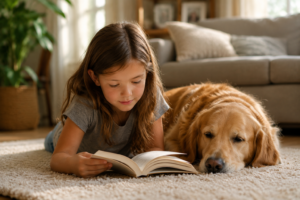
Dogs live entirely in the present. They don’t worry about yesterday or tomorrow. When your child lies on the floor with the dog, scratching behind its ears, they are pulled — effortlessly — into the present moment too. In a world of relentless digital distraction, a dog is one of the few forces in a child’s life that consistently pulls them back to now. That’s not nothing. That might be everything.
“The relationship between a child and their dog is one of the most reliable sources of emotional learning available — and it’s happening whether parents are paying attention or not.”
— Children’s Hospital Colorado, on the developmental benefits of family pet ownership
How to Be an Active Part of These Lessons
The lessons above happen passively — but parents who engage with them actively multiply their impact. A few simple practices:
Name what’s happening. When the dog shows patience or the child shows empathy toward the dog, say it out loud. “Did you notice how gently you approached him just then? That was real kindness.” Naming the behaviour cements the lesson.
Include kids in real decisions. “The dog seems tired today — what do you think she needs?” Asking children to observe and respond to the dog’s needs builds both empathy and critical thinking in one conversation.
Let them experience the hard parts too. The vet visit. The sad day. The frustrating training session. Protecting kids from every difficult dog moment robs them of the emotional growth those moments offer.
Talk about the dog as a family member with feelings. Not in an anthropomorphizing way that confuses reality, but in a way that acknowledges the dog’s emotional life. Science is increasingly clear that dogs have rich emotional experiences. Treating that seriously helps children develop the habit of extending care and consideration to all living things.
The Bottom Line
Your dog is not just a pet. They are a daily, living curriculum in the most important subjects a child will ever study: empathy, responsibility, patience, grief, boundaries, acceptance, and presence. The classroom is your living room. The teacher has four legs and never takes a day off.
Pay attention. And every once in a while, get down on the floor with them both.
Sources & Further Reading
- Human-Animal Bond Research Institute (HABRI). National survey on pet ownership and emotional wellbeing.
- Hawkins, R.D., Robinson, C., & Brodie, Z.P. (2022). Child–Dog Attachment, Emotion Regulation and Psychopathology. Behavioral Sciences, 12(4), 109.
- Children’s Hospital Colorado. Benefits of Pets for Kids. childrenscolorado.org
- Purewal, R., et al. (2017). Companion Animals and Child/Adolescent Development. International Journal of Environmental Research and Public Health, 14(3), 234.
🙋 FAQ Section
Q: What life lessons do dogs teach children? A: Dogs teach children empathy, responsibility, patience, healthy boundaries, grief, unconditional acceptance, and present-moment awareness — often more effectively than any structured lesson.
Q: How do dogs help children develop empathy? A: Dogs communicate entirely through body language and tone. Children who live with dogs naturally learn to read non-verbal cues and respond to the emotional needs of others — a skill that transfers directly to human relationships.
Q: At what age can a child start learning from a family dog? A: Even toddlers benefit from early supervised interactions with a family dog. The empathy and responsibility lessons deepen as children age and take on more active care roles.