
|
Getting your Trinity Audio player ready...
|
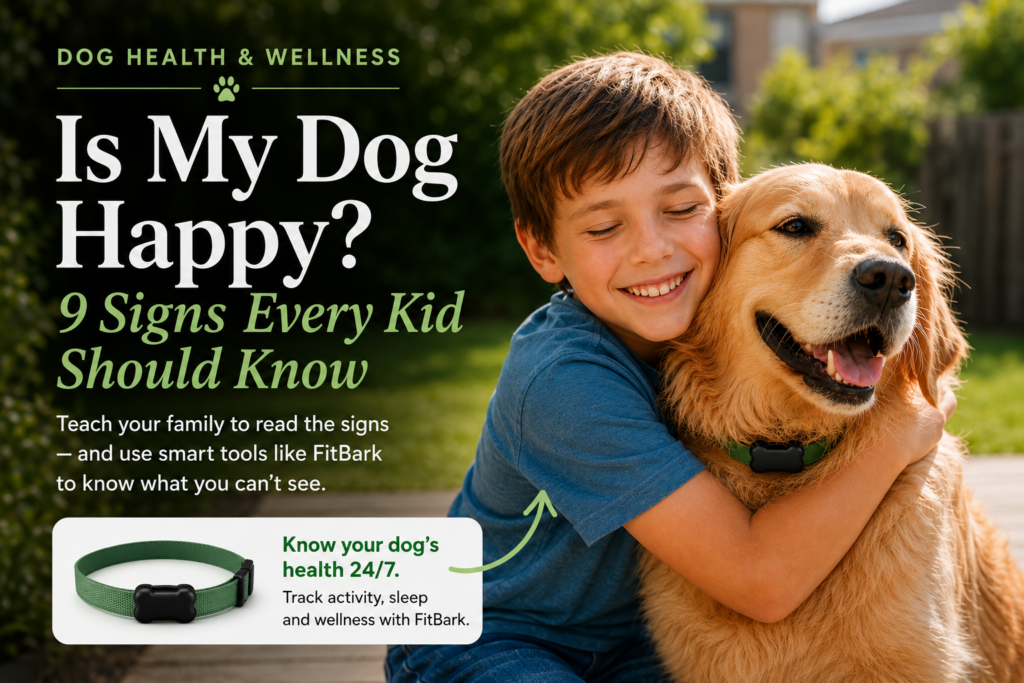
Dog Health & Wellness
Is My Dog Happy?
9 Signs Every Kid in Your Family Should Know
Teaching children to read their dog’s emotional state isn’t just sweet — it’s a safety skill and a superpower that lasts a lifetime.
Here’s something that surprises most parents: children who can read their dog’s body language are statistically less likely to be bitten by a dog. Not just their own dog — any dog. The ability to notice what a dog is communicating is one of the most practical safety skills a child can have, and it starts at home with your own family dog.
But there’s something beyond safety here, too. A child who learns to ask “is my dog happy right now?” is learning to ask “how is the person I’m with feeling right now?” They’re learning to look outward, to read others, to put someone else’s experience at the centre of their awareness. That’s the foundation of emotional intelligence.
Here are nine signs of a genuinely happy, well-adjusted family dog — explained in language you can use with your kids at any age.

9 Signs Your Dog Is Thriving
A happy dog looks loose. Their whole body moves — not just the tail. The difference between a stiff dog and a relaxed dog is immediately visible once you know to look for it. Teach your kids: “Is their body wobbly or rigid?” Wobbly is happy. Stiff is a signal to give space.
Happy dogs have soft, almond-shaped eyes that blink naturally. They’re not staring hard, whites aren’t showing (what trainers call “whale eye”), and their forehead isn’t furrowed. The face tells you almost everything. Teach your kids to check the dog’s eyes before approaching.
Here’s a nuance most people miss: it’s not just about whether the tail is wagging — it’s about how. A tail held very high and wagging stiffly can signal arousal or tension. A tail held mid-height or lower, wagging in big, sweeping arcs (or even helicopter style), is the real happy wag. Teach this distinction and kids will read tail language far more accurately.
A dog who eats with enthusiasm and finishes their meals consistently is a dog whose emotional and physical state is generally good. Changes in appetite — eating less, eating much faster, skipping meals — are often the first and clearest signal that something is off. This is one kids can easily monitor if they’re involved in feeding.
The play bow — front legs down, bottom up, eyes bright — is the universal dog invitation. “Come play with me.” A happy dog does this regularly and seeks out their family members for interaction. A dog who withdraws, hides, or stops initiating play is a dog worth paying closer attention to.
Dogs sleep 12–14 hours a day on average, and the quality of that sleep matters as much as the quantity. A dog who sleeps soundly and wakes up ready to engage is a dog who is genuinely resting. A dog who sleeps fitfully, paces at night, or seems exhausted during the day despite sleeping plenty may be carrying stress, pain, or anxiety their body is working through.
Physical wellness and emotional wellness are deeply connected in dogs. A happy, well-nourished, low-stress dog typically has a glossy coat, clear bright eyes, and good energy. Dull coats, excessive shedding, runny eyes, or lethargy are physical signs that often reflect something worth checking — nutrition, stress, or an underlying health issue.
A dog who gets enough exercise is genuinely calmer, happier, and more emotionally balanced. The flip side: a dog who isn’t meeting their exercise needs often shows it through restlessness, destructive behaviour, or anxious energy. Happy dogs have an outlet. They walk, run, fetch, and play — and then they rest contentedly.
A dog who chooses to be near the family — not because they’re forced to, but because they want to be in the same room, on the same couch, at your feet — is a dog who feels safe and loved. Watch where your dog gravitates when they have a free choice. That tells you more about their wellbeing than almost anything else.

⚠️ Signs to Take Seriously
Teach your kids these as the flip side — signals worth telling an adult about immediately:
- Appetite changes lasting more than a day or two
- Hiding or avoiding the family
- Excessive licking of paws or one area of the body
- Panting or pacing when there’s no obvious reason
- Growling, snapping, or unusual irritability
- Sudden changes in energy — much more tired or much more restless than normal
“Children who learn to observe and respond to their dog’s emotional signals develop measurably stronger social cognition — the ability to understand what others are feeling.”
— Research on children, dogs and socio-cognitive development, 2024
The best way to teach dog wellness awareness to kids isn’t a lecture — it’s a daily check-in habit. Some families make it part of the morning routine: a quick “how’s the dog today?” conversation at breakfast. Others make it part of the evening walk. Whatever fits your rhythm, the goal is the same: make noticing a habit, not a reaction.
Kids who grow up asking “how is my dog feeling?” become adults who ask “how is the person I’m with feeling?” That’s not a small thing. That might be the most important thing.
Sources & Further Reading
- Research on Children and Dogs: Exploring the Impact of Canine Interaction on Socio-Cognitive Development. Gyermeknevelés Tudományos Folyóirat, 2024.
- American Veterinary Medical Association. Dog Bite Prevention — Body Language Resources.
- PetMD. 4 Most Common Sleep Disorders in Dogs. petmd.com
- Hawkins, R.D., et al. (2022). Child–Dog Attachment, Emotion Regulation and Psychopathology. Behavioral Sciences, 12(4).