
|
Getting your Trinity Audio player ready...
|
Kids & Dogs Growing Up Together
The Age-by-Age Guide to Giving Kids Dog Responsibilities
The right job at the right age builds confidence, empathy, and a lifelong bond. Here’s exactly what works — and what to wait on.
One of the most common mistakes well-meaning dog families make is either doing everything for the dog themselves, or handing kids responsibilities they’re not developmentally ready for. Both backfire. The first robs children of one of the richest learning experiences available to them. The second sets them up to fail and feel guilty when the dog suffers for it.
The sweet spot — the right responsibility at the right age — is where the magic lives. It’s where a child discovers they are capable of caring for another living thing. Where a dog learns to trust a small human. Where a family builds something that will last far longer than childhood.
Here’s the guide that nobody handed us when we got a dog and had kids at the same time.
⚠️ The Golden Rule First
No child of any age should ever be the sole responsible party for a dog’s care. Children can be genuine contributors and even primary caregivers for specific tasks — but an adult must always maintain overall oversight. A child who forgets to feed the dog should have a parent who catches it, not a dog who goes hungry. Keep that boundary clear, and the rest of this guide works beautifully.
Age-by-Age Breakdown
- Help carry the food bowl (with adult holding it too)
- Drop a single treat into the bowl at feeding time
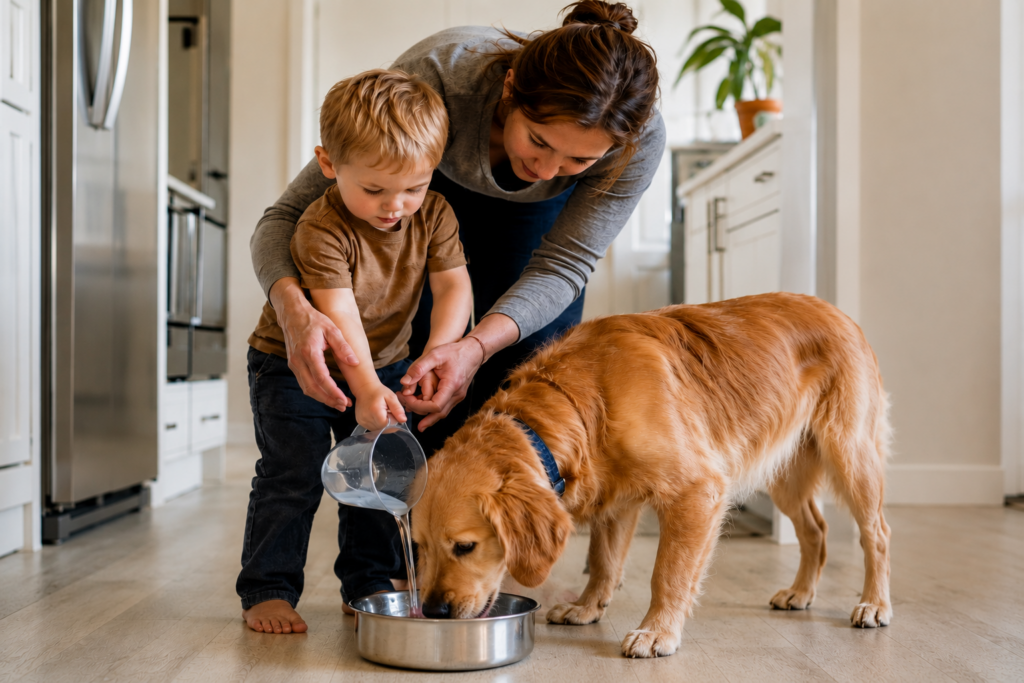
- Help pour water into the dog’s dish with a small cup
- Pat gently — with an adult hand guiding theirs
Focus here is not responsibility — it’s connection and safety. Teach “gentle hands” as a constant refrain. Supervision is 100% required at this age.
- Refill the water bowl independently (with reminders)
- Help carry the food bag from storage to feeding area
- Fetch the dog’s leash before walks
- Help choose which toy to bring to the park
- Assist with brushing — holding the brush with an adult guiding
Pride in contribution is the goal. Celebrate every successful task. Don’t assign sole ownership of anything yet — make it “our job together.”
- Scoop and serve the dog’s food at designated meal times
- Ensure the water bowl is always full — check once in the morning
- Help with short, supervised walks around the block
- Assist with brushing a short-coated dog independently
- Help tidy dog toys at the end of the day
- Learn to identify signs the dog needs outside time
A visual chore chart works brilliantly at this age. Kids this age love checking things off and seeing their contribution made visible.
- Take ownership of morning feeding routine with minimal reminders
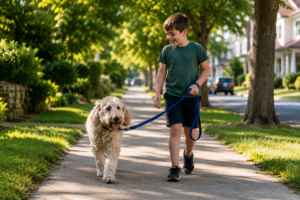
- Walk the dog independently in a safe, familiar neighbourhood
- Learn to pick up after the dog on walks
- Help with basic training reinforcement (sit, stay, down)
- Help with bath time — including rinsing and drying
- Notice and report changes in the dog’s behaviour or appetite
This is the golden age for dog-child relationships. Kids this age are developmentally primed for this level of responsibility and will rise to it with enthusiasm when given genuine ownership.
- Manage feeding schedule for a full week independently
- Walk the dog daily, including in less familiar areas
- Lead basic training sessions using positive reinforcement
- Handle grooming for most breeds
- Help track the dog’s health — appetite, weight, energy, behaviour changes
- Research breed-specific needs and advocate for the dog’s health
“Getting kids and dog responsibilities right at every age is one of the most rewarding investments a dog family can make.”
Preteens can be extraordinary dog stewards. The key is trusting them with real responsibility — not just symbolic tasks — while staying available as the safety net.
- Manage all daily care tasks independently
- Research dog nutrition, activity needs, and health signals
- Take the dog to vet appointments with a parent
- Help train younger siblings in appropriate dog interaction
- Take genuine emotional ownership of the dog’s wellbeing
A teenager who has grown up with dog responsibility has a significant head start on the empathy, reliability, and living-thing awareness that defines emotional maturity.
“Learning responsibility with a pet is one of the greatest incentives available to parents — because the pet’s wellbeing makes it real in a way that abstract tasks never can.”
— Children’s Hospital Colorado, on pet ownership and child development
What Happens When You Get This Right
Families who involve children meaningfully in dog care — at the right ages, with the right tasks — report something that’s hard to quantify but impossible to miss: the bond between child and dog becomes something different. More mutual. More chosen. The dog isn’t something that lives at the house. It’s someone the child has actively cared for, worried about, and shown up for.
That’s not just a better relationship with the dog. It’s a better kind of person growing in your house.
Sources & Further Reading
- Children’s Hospital Colorado. Benefits of Pets for Kids. childrenscolorado.org
- Animal Protective Foundation. Teaching Young People Responsibility Through Pet Care. animalprotective.org
- Penniless Parenting. 8 Ways to Teach Kids Responsibility Through Pet Care (2025). pennilessparenting.com
🙋 FAQ Section to Add
(Paste this at the bottom of your post — Google loves FAQ schema for these exact questions)
Q: What age can a child start taking care of a dog? A: Children as young as 2–3 can help with simple tasks like refilling the water bowl under supervision. Meaningful independent responsibility typically starts around age 6–7, with near-full stewardship possible by age 11–13.
Q: What dog chores are appropriate for a 5 year old? A: Five year olds can help carry the food bag, fetch the leash before walks, assist with gentle brushing, and help choose the dog’s toys — all with adult oversight.
Q: Can a 10 year old take care of a dog by themselves? A: A 10 year old can manage most daily dog care tasks including feeding, walking in familiar areas, and basic grooming — with a parent as the overall safety net rather than hands-on supervisor.
Q: How do dog responsibilities help kids develop? A: When children are given age-appropriate dog duties, they don’t just help out — they grow up more confident, empathetic, and resilient.