
|
Getting your Trinity Audio player ready...
|
Dog Health & Family Wellness
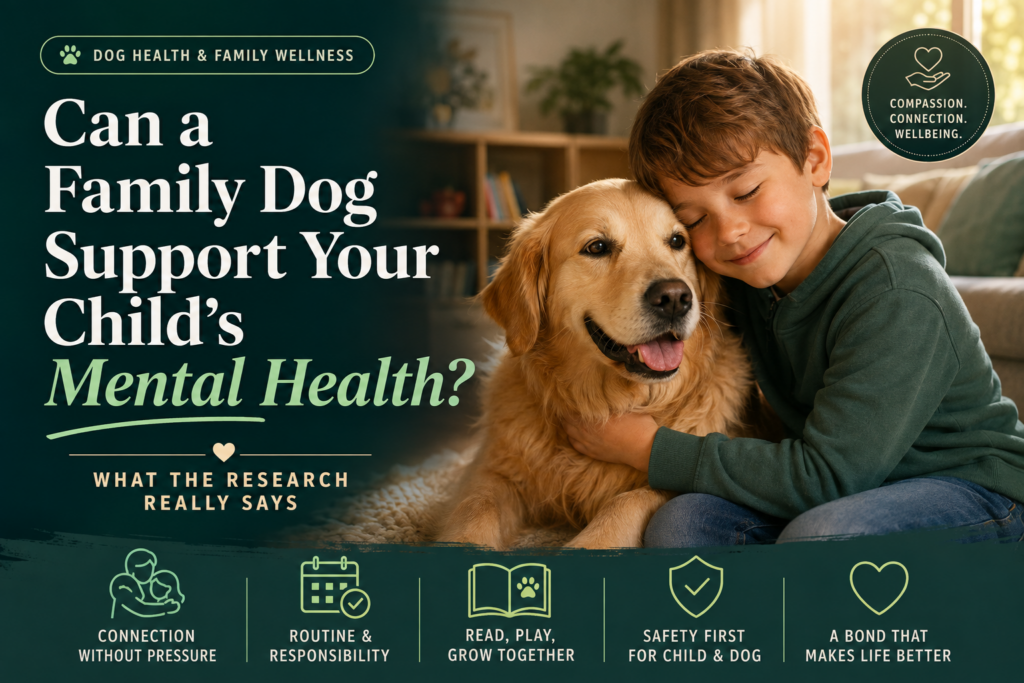
Can a Family Dog Support Your Child’s Mental Health?
What the research really says about dogs, children’s wellbeing, and the small everyday moments that help a healthy bond grow.
By Best Family Dogs · Evidence-informed · Updated August 2026
A family dog can bring comfort, routine, outdoor time, and a sense of connection to a child’s day. Those things matter. But parents deserve a clear answer — not a sales pitch: a dog is not a treatment for anxiety, depression, ADHD, autism, or any other mental-health condition. The research is encouraging in places, mixed in others, and still developing.
The short answer
A calm, well-matched dog may support a child’s wellbeing through companionship, shared routines, play, and family connection. Studies show associations between pet relationships and outcomes such as lower loneliness or better self-esteem, while stronger claims about preventing or treating mental-health conditions are not yet established. The quality of the relationship — and the dog’s welfare and safety — matter far more than ownership alone.
What the Evidence Actually Shows
It helps to separate two different questions. Pet ownership research asks whether children who live with dogs have different outcomes from children who do not. Most of this work is observational — it can identify a relationship but cannot prove that a dog caused it. Dog-assisted interventions are structured programmes run by trained professionals with certified dogs. They are not the same as bringing home a family pet.
A 2025 Royal Veterinary College survey of 382 caregivers and 216 children found that many parents felt their dog provided mental health benefits to their children, and children reported feeling comfort and happiness from their dogs. However, more than one-third of adults who served as the primary puppy caregiver found having a puppy harder than expected. That nuance matters: the benefits are real for many families, and so are the challenges.
Some associations are promising
A peer-reviewed systematic review found evidence of associations between pet ownership and emotional benefits — especially self-esteem and loneliness. Evidence on childhood anxiety and depression was inconclusive and higher-quality long-term studies were identified as needed.
Bond quality appears to matter
One longitudinal study linked childhood pet-dog exposure with a lower risk of later mental-health diagnosis after adjustment for confounders. A stronger attachment to the pet was associated with lower risk. These are associations — not proof of protection.
Dog-assisted interventions: potential with limits
A systematic review of randomised trials found some positive findings, particularly for social skills and behaviour, but reported variable methods and limited trial quality. It concluded that dog-assisted interventions may show promise — not that they are established care.
A low-pressure practice idea
Reading to a calm dog may make practice feel more comfortable for some children. A systematic review found possible benefits, but the underlying evidence was low quality. Enjoy it as a routine — not a guaranteed reading intervention.
Companionship and loneliness
Children aged 7 to 8 often ranked pets higher than humans as providers of comfort and self-esteem. Animal-assisted therapy with dogs has shown positive outcomes in hospital settings, helping normalise the experience for paediatric patients and their families.
Behavioural health associations
Research investigating whether pet dogs are positively associated with mental health in children aged 4 to 10 found encouraging associations — and concluded that positive child-dog interactions could form one part of a broader foundation for childhood wellbeing.
That nuance is good news, not a disappointment. It lets families appreciate a dog for what a dog genuinely can be: a beloved companion whose everyday presence may contribute to a wider foundation for wellbeing — alongside sleep, movement, supportive relationships, school support, and professional care when needed.
“A dog should be viewed as a family relationship and a responsibility — not a mental-health prescription.”
— Best Family Dogs, best-family-dogs.com — evidence-informed editorial, August 2026
How a Family Dog May Support a Child’s Wellbeing
Every child and dog is different, but these are the pathways parents most consistently recognise — and that research most frequently points to:
Connection without pressure
For a child who has had a difficult day, sitting beside a familiar dog offers quiet companionship without expectation. That is different from claiming a dog cures loneliness or anxiety. It is simply a dependable relationship that can feel safe and comforting in moments when other forms of connection feel harder.
Predictable routines and shared responsibility
Feeding, brushing, training, and walking can give a child an age-appropriate role in the family. Keep responsibility genuinely shared with adults — a child should never carry the full burden of a dog’s care. Done well, routine dog care builds a sense of purpose and reliability that supports emotional wellbeing.
Play and time outdoors
Dogs can make family walks and outdoor play easier to begin and maintain. Regular movement and time outside are worthwhile for their own sake — and a dog is a natural motivator for both. For ideas that fit your dog’s stage and energy level, see our family dog fitness guide.
Emotional learning — with adult guidance
With active adult guidance, children can learn to notice a dog’s signals, respect their boundaries, and respond with kindness: “She’s turned away — let’s give her space right now.” That kind of guided observation develops empathy while protecting the dog from unwanted interaction. For more on this, read our dog body language guide for kids.
Five Healthy Ways to Build the Dog-Child Bond at Home
1
Create a calm after-school routine
Offer a short, adult-supervised walk, a gentle training game, or quiet time near the dog. Let your child opt in — connection should never be forced on a child or on the dog.
2
Give your child a real, age-appropriate dog job
A young child might refill the water bowl with adult help. An older child might help prepare food or practise a training cue. Adults remain responsible for the dog’s welfare at all times.
3
Read nearby, if the dog enjoys it
Settle the dog comfortably in their own space, then invite your child to read aloud for a few minutes. Stop if the dog leaves or shows stress signals — the dog’s comfort is not optional.
4
Teach consent in dog language
Show children that turning away, lip-licking, freezing, hiding, or walking off can mean “I need space right now.” Explore our complete dog body language guide together as a family activity.
5
Protect the dog’s downtime — it protects everyone
Every dog needs a child-free retreat they can always access. Quiet rest, predictable routines, proper exercise, and regular veterinary care help a dog feel secure — and a secure, well-cared-for dog is an essential part of a safe family relationship.
When a Dog Is Not the Answer — and What to Do Instead
If there is immediate risk of harm, contact local emergency services or a crisis service right away.
Dog safety is part of child wellbeing too
Never leave a young child unsupervised with a dog, even a gentle and familiar one. Always give the dog space while eating, sleeping, chewing, unwell, injured, or trying to get away. How well a dog and child relationship works depends far more on preparation, supervision, and ongoing guidance than on any breed label.
Frequently Asked Questions
Can a family dog help a child with anxiety?
A calm, well-matched dog may be a comforting companion and can support routines, activity, and connection. Research on animal-assisted interventions is promising but mixed — pet ownership does not treat an anxiety disorder. If anxiety disrupts your child’s daily life, seek guidance from a qualified healthcare professional.
Do dogs improve children’s mental health?
Some studies associate a strong pet relationship with lower loneliness and better wellbeing, but much of this research is observational and cannot prove that a dog caused those outcomes. A dog should be a family commitment — not a mental-health prescription.
Is a dog a good idea for a child with ADHD or autism?
Some structured dog-assisted programmes show potential for social, behavioural, or anxiety-related outcomes, but results vary and study quality is mixed. A dog cannot replace individual clinical assessment, therapies, school support, or medical care. Always consider the child’s needs, the dog’s temperament, and the family’s realistic capacity before deciding.
Can reading to a dog help a child?
It can be an enjoyable, low-pressure practice habit for a child and a dog who both enjoy it. A systematic review found possible benefits but the evidence quality was low. Use it as a pleasant complement to regular reading support — not a standalone intervention.
What makes a dog safe and good with children?
Temperament, early experiences, consistent training, good health, predictable handling, and active adult supervision all matter. No breed is automatically safe or the right fit for every family — individual assessment of the dog and the family’s situation is always needed.
Should I get a dog to help my child’s mental health?
A dog should not be acquired primarily as a mental health intervention. If your child is struggling, speak with a healthcare professional first. A dog can be a meaningful companion alongside professional care — but the dog’s lifelong needs, and the family’s capacity to meet them, must come first.