
|
Getting your Trinity Audio player ready...
|
Dog Biometrics for Families
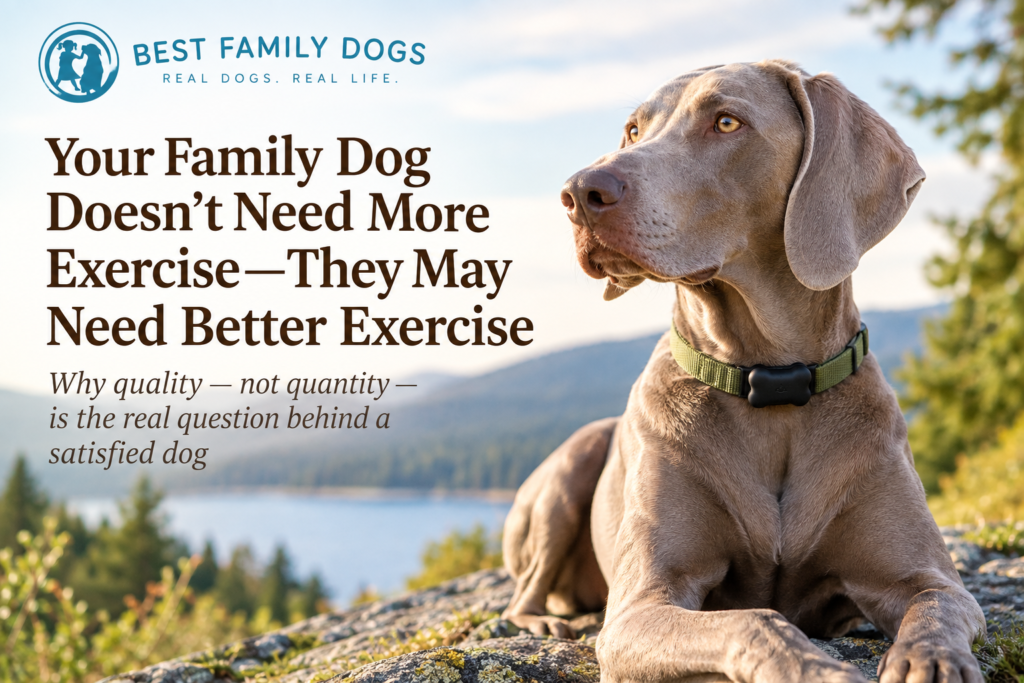
Your Family Dog Doesn’t Need More Exercise—They May Need Better Exercise
Why quality — not quantity — is the real question behind a satisfied dog
It’s not bad advice, exactly. But it’s incomplete — and for a lot of family dogs, it’s not even the right question.
More exercise isn’t always better for dogs. The right amount depends on your dog’s age, breed, body condition, personality, and individual needs. A satisfied dog usually needs a mix of walking, sniffing, play, free movement, mental stimulation, and rest — not simply more minutes of physical activity.
The “More Is Better” Myth in Dog Exercise Culture
It’s an easy trap to fall into. If a 20-minute walk is good, a 40-minute walk must be better. If one game of fetch tires your dog out, three games must really do the trick. More effort feels like more care.
But dogs aren’t machines that simply need more fuel burned. Past a certain point, adding more physical activity doesn’t necessarily make a dog happier or healthier — it can just make them more tired, or in some cases, more wound up rather than settled.
What Does a Good Dog Exercise Routine Actually Include?
“Exercise” is really shorthand for several different things, and a satisfied dog usually needs a mix of movement, sensory engagement, mental stimulation, and genuine rest — not maximum quantity of just one thing:
- Walking — steady movement, a change of scenery, time outdoors
- Sniffing — sensory engagement and mental processing of the environment
- Play — social interaction, fun, a different kind of physical output
- Free movement — off-leash or open-space time to move at their own pace
- Mental stimulation — training, puzzles, problem-solving, novelty
- Rest — genuine downtime to process and recover
A dog who gets plenty of walking but none of the others can still end up unsatisfied. A dog who gets a little of each, in the right balance, often seems more content than one who gets a lot of just one thing.
How Age, Breed, Body Condition, and Health Change the Equation
What “better” looks like isn’t the same for every dog. A young, high-drive working breed might need more mental stimulation and purposeful activity to feel satisfied. A senior dog might need the same six components in smaller, gentler doses, with more emphasis on rest and less on sustained physical exertion.
A dog carrying extra weight may benefit from gradually increasing appropriate, low-impact movement rather than suddenly adding intensity — particularly if exercise tolerance is limited. If your dog’s exercise tolerance has changed suddenly, that’s a reason to talk with your veterinarian rather than simply increasing activity.
None of this is a chart you can look up. It’s something you learn by paying attention to your own dog’s responses over time — what leaves them calm and settled, versus what leaves them wound up or exhausted in a way that doesn’t seem to satisfy anything.
What Activity Data Reveals About Quality vs. Quantity
This is where activity data earns its place — not as a way to chase a bigger number, but as a way to see the pattern. Instead of just asking “how much did my dog move today,” you can start noticing the shape of the day: a lot of steady activity with very little rest, or a relatively quiet day with plenty of sleep and shorter bursts of movement and play.
That doesn’t tell you exactly what your dog needs, and it shouldn’t replace paying attention to your dog or talking with your veterinarian when something changes. But it can give you another piece of information to compare over time.
Seen that way, the data isn’t pushing you toward more. It’s helping you notice patterns — which is a very different, and often more useful, question.
How to Build a Better Dog Exercise Routine — Not Just a Longer One
In practice, this often means less time spent wondering “did we do enough today” and more time asking “did today have a good mix.” A shorter walk with plenty of sniffing might do more for your dog than a longer one at a forced pace. Ten minutes of a new training game might satisfy something a second walk never would. And sometimes, the most useful thing you can add to your dog’s day isn’t more activity at all — it’s more rest.
Our Take
We spent a lot of Titan’s life assuming that if he seemed restless, the answer was another walk. It rarely occurred to us that what he might have needed some days was less activity and more rest, or a training game instead of a second lap around the block.
We didn’t have any data to help us see that pattern at the time — just trial and error, and a lot of guessing. Looking back, that’s exactly the kind of situation where activity data could have been useful. Not to tell us what Titan needed, but to help us see the actual shape of his days and notice patterns we might otherwise have missed.
Frequently Asked Questions
Is more exercise always better for dogs?
No. Past a certain point, adding more physical activity doesn’t necessarily improve a dog’s wellbeing — it can lead to over-tiredness or restlessness rather than genuine satisfaction. A balanced mix of activity, enrichment, and rest is usually more effective than simply increasing volume.
Can a dog get too much exercise?
Yes. The appropriate amount of exercise varies by the individual dog, and too much or overly intense activity can leave some dogs overtired, sore, or unable to settle. Puppies, seniors, dogs carrying extra weight, and dogs with health or mobility concerns may have particularly different limits. If your dog’s exercise tolerance changes, check with your veterinarian rather than simply adding more activity.
What does a dog actually need besides walks?
Sniffing, play, free movement, mental stimulation, and rest all play a role alongside walking. A dog who only gets walks but none of the others may still seem unsatisfied even with plenty of exercise minutes logged.
How do I know if my dog needs more activity or more rest?
Look at the pattern, not just the day. If your dog seems consistently wound up despite lots of activity, they may need more mental stimulation or rest rather than more exercise. If they seem consistently low-energy and disengaged, added enrichment or activity may help more than additional rest.
Related: Why Your Dog’s Walk Distance Doesn’t Tell the Whole Story · How Much Exercise Does a Family Dog Really Need?