
|
Getting your Trinity Audio player ready...
|
Best Family Dogs · Family Dog Safety
Living with a Senior Dog and Young Kids:
What Every Family Needs to Know
How to protect your older dog, keep your children safe, and help them grow closer — from a family raising kids alongside Titan, our senior dog.
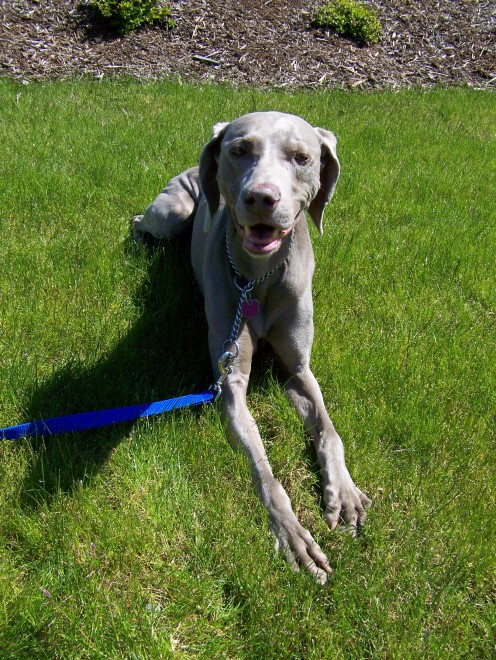
Why Senior Dogs Behave Differently Around Children
Before we talk safety or strategy, it helps to understand what’s actually happening in your older dog’s world. A senior dog is not a younger dog who’s slowed down. Their entire sensory experience has changed.
- Hearing loss — an older dog may not hear your child approaching, causing startled reactions that look aggressive but are actually just fear
- Vision changes — reduced peripheral vision means fast-moving small people are genuinely harder to track
- Joint pain — what looks like grumpiness is often discomfort; a child touching a sore hip can trigger a snap from the gentlest dog
- Lower stress tolerance — the chaos of young children is genuinely more overwhelming for an older dog’s nervous system than it was when they were young
- Sleep is sacred — senior dogs sleep more deeply and need more rest; interrupting sleep is one of the most common triggers for stress responses around kids
Understanding this isn’t about making excuses for your dog — it’s about setting up an environment where neither your child nor your dog ever ends up in a situation that goes wrong.
Signs Your Senior Dog Is Stressed Around Your Kids
One of the most important things any parent can do is learn to read their dog’s stress signals before a situation escalates. By the time a dog growls or snaps, they’ve usually been communicating discomfort for a while — we just missed it.
Early warning signs to watch for:
- Lip licking or yawning when children are nearby — not tiredness, but a calming signal
- Whale eye — whites of the eyes visible, head turned slightly away
- Stiff body or tail — freezing in place rather than relaxed movement
- Low head position with ears back — actively trying to make themselves smaller
- Moving away repeatedly — if your dog keeps leaving the room, they are communicating clearly
- Refusing food in the presence of children — stress high enough to override appetite
“The best thing I ever did was teach my kids that when Titan walks away, the interaction is over — full stop. Respecting that boundary has kept their relationship genuinely loving.”
How to Protect an Older Dog from Kids (Without Isolating Them)
The instinct many parents have is to separate their senior dog completely when kids are around. This feels safe, but it can actually backfire — social isolation increases anxiety in dogs, which makes stress responses more likely, not less. The goal is structured access, not separation.
Create a dog-safe zone your children respect
Titan has a spot in our home that belongs entirely to him — a bed in a quieter room with a baby gate he can hop over but the toddler can’t. This is his decompression zone, not a punishment. The rule in our house is simple: if Titan is in his spot, nobody goes to him. The children learned this early and take genuine pride in honouring it.
Manage introductions after arrivals home
Children running through the door and immediately seeking the dog is one of the highest-risk daily moments for a senior dog. Practice calm arrivals — remove shoes, settle bags, then greet the dog on the dog’s terms. It sounds small. It makes a real difference.
Designate “dog-free” times for napping
If your senior dog naps in the afternoon, make that a child-free zone around them. An undisturbed sleep cycle is genuinely protective — for your dog’s nervous system and for your household’s safety record.
Teach children the right way to approach
Children should approach a senior dog from the front, never from above or behind. They should crouch down to the dog’s level, offer a closed fist to sniff, and wait. This isn’t just politeness — it’s the difference between a calm greeting and a startled dog.
Is a Senior Dog Safe Around a Toddler?
This is the question parents search for most, and it deserves a real answer rather than a blanket reassurance. The honest answer is: it depends on the individual dog, your home setup, and how well supervised the interactions are — not on age alone.
A well-known senior dog with a calm temperament, in a home with educated children and attentive parents, can absolutely be safe around toddlers. Many senior dogs are better with young children than younger dogs precisely because they’re past their reactive, high-energy phase. Titan is calmer and more tolerant with our kids now than he was at three years old.
What changes the calculation is:
- Whether your dog has any pain-related reactivity you haven’t yet addressed with your vet
- Whether toddlers can be supervised consistently — young children genuinely cannot read canine body language, so adult oversight is non-negotiable
- Whether your dog has a safe retreat they can use on their own terms
- Whether you’ve taught your children the rules and reinforced them consistently
No dog — regardless of breed, age, or history — should be left alone with a child under 6 without direct adult supervision. This is a universal guideline from veterinary and child-safety organizations, not a reflection on your dog’s character.
If your senior dog has shown any pain-related snapping or resource guarding, speak with your vet before adjusting your management approach. Pain management (joint supplements, anti-inflammatory medication) can significantly improve temperament in older dogs.
Senior Dog Behaviour Changes Around Children: When to See the Vet
Sometimes what looks like a dog “getting worse with the kids” is actually a dog in unaddressed physical pain. This is one of the most underrecognised patterns I’ve seen — and one of the most fixable.
If you notice your senior dog becoming increasingly irritable, less tolerant of touch, or more reactive around your children than they used to be, schedule a vet appointment before addressing it as a behaviour problem. Common culprits include:
- Arthritis or hip dysplasia — pain when touched or during fast movements around children
- Dental disease — mouth pain makes dogs grumpy and less tolerant overall
- Cognitive Dysfunction Syndrome (CDS) — canine dementia, which can cause confusion and anxiety
- Vision or hearing decline — when sudden moves from children become genuine startles
- Thyroid changes — can affect mood and stress tolerance significantly
Getting these addressed doesn’t just help your dog — it directly improves the safety and quality of their relationship with your children.
The Gift of Growing Up Alongside an Older Dog
I want to end here, because most articles about senior dogs and young kids read like risk assessments. And yes — there are real things to manage. But there’s something profound happening in your home that deserves to be named.
Children who grow up with a senior dog learn things a young, bouncy puppy can’t teach them as easily. They learn to slow down and observe. They learn that love sometimes means sitting quietly next to someone instead of playing. They learn that bodies get older and need more care, and that this isn’t sad — it’s just part of life, and you stay beside someone through it.
Titan has taught my children more about gentleness, patience, and loyalty than I ever could have planned. That’s not a small thing. That’s one of the real gifts of sharing your family years with a senior dog.
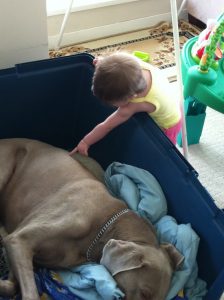
“Watching my child sit quietly beside Titan and just rest a hand on his side — that’s the moment I knew this was worth every bit of the effort.”
Quick Reference: Senior Dog and Young Kids Safety Checklist
- Create a dog-safe zone children respect as off-limits
- Teach calm arrivals home — no rushing the dog at the door
- Teach children to approach from the front, crouch down, wait for the sniff
- Recognise early stress signals and end interactions before they escalate
- Protect nap times — don’t allow children to wake a sleeping senior dog
- Rule out pain before treating irritability as a behaviour problem
- Never leave children under 6 alone with any dog unsupervised
- Monitor health changes with regular vet checks and activity tracking
Have questions about living with a senior dog and young children? Drop them in the comments — I read every one. And if this helped, share it with another family navigating the same beautiful, complicated journey.