
|
Getting your Trinity Audio player ready...
|
Real-Life Family Stories
The Real Story of Bringing a
Second Dog Home
When You Have Kids
Nobody warns you how complicated the first three weeks will actually be. Here’s what to expect — and how to get through it as a family.
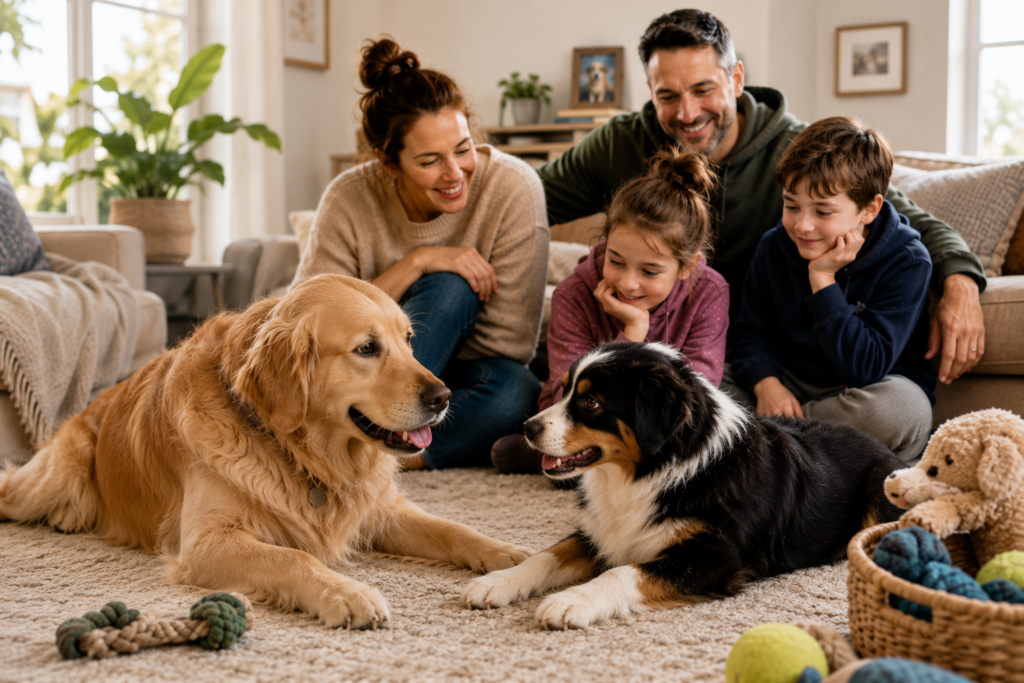
The second dog feels like a great idea right up until they walk through your front door. Then your first dog stares at you with an expression that says “explain yourself.” Your youngest child immediately tries to hug the new dog around the neck. Your oldest gets protective of the original dog. And the new dog, overwhelmed by all of it, disappears under the couch.
This is the moment every two-dog family remembers.
The transition to two dogs when you have children in the house is more complex than either experience alone — getting a first dog, or having multiple kids. It involves two animals who need to establish a relationship, children who each have their own feelings about it, and parents trying to manage all of it while still making dinner. But it is absolutely navigable, and most families who push through the first month describe the outcome as one of the best decisions they ever made.
Here’s the honest, week-by-week account of what that first month actually looks like.
Before You Bring the Second Dog Home
The single most important factor in a smooth transition is the introduction — and it should happen on neutral territory, not in your home. Let the dogs meet at a park or on a quiet street first, walked parallel to each other by two adults. Letting them meet at the front door of your house — where your resident dog is territorial — is the most common mistake families make. A calm first meeting on neutral ground changes everything.
The First Month: Week by Week
Parallel Living — Keep Everything Separate
Separate feeding stations, separate sleeping areas, separate toys. Let them share space but not resources. Watch for resource guarding (growling near food, toys, or you) and separate immediately if it appears. Don’t force interaction — let them approach each other on their own terms. Explain this clearly to your children: “We give the dogs space to get to know each other, just like you’d want space with a new person.” Kids understand that framing immediately.
First Signs of a Relationship Forming
You’ll start to see tentative play attempts — usually a play bow from one dog toward the other. Supervised playtime can begin in short bursts. Your children should watch these interactions as observers at first, not participants. This is actually a great opportunity: watching two dogs navigate a new relationship teaches kids more about social dynamics than almost any conversation could.
The Regression Dip
Almost every two-dog family reports a dip in week three. The novelty has worn off, everyone is tired, and the resident dog may start expressing frustration — increased reactivity, attention-seeking, or subtle dominance behaviors. This is normal and temporary. The key is not to overcorrect: don’t punish the resident dog for being unhappy, and don’t flood the new dog with forced social time. Keep routines consistent and let the relationship develop at its own pace.
The Turn — When It Starts to Feel Real
Around week four, something shifts. The dogs start choosing to be near each other. You’ll find them sleeping in proximity without being placed there. Play becomes reciprocal — both dogs initiating. Your children will notice it immediately. “They’re actually friends now.” That moment is worth all of the weeks that came before it.
Involving Your Kids at Each Stage
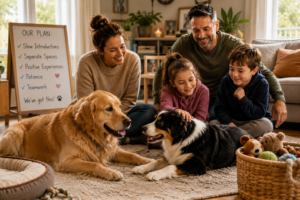
Give each child a specific role. One child is in charge of the first dog’s feeding. Another helps settle the new dog at bedtime. Specific roles prevent the jealousy that can arise when kids feel like the new dog is getting more attention or their dog is being neglected.
Have honest conversations about feelings. Kids get attached to the family dog’s identity as “our dog.” A second dog can feel threatening to that. It’s okay to acknowledge: “I know it feels weird to share Biscuit with a new dog. That’s a normal feeling. Biscuit is still your dog. She’s just going to have a friend now.”
Let them witness the relationship building. Some of the richest conversations we’ve had with our kids have come from watching the two dogs figure each other out — negotiating play, sharing space, showing deference and affection. It’s a real-time course in relationships.
“The moment our kids realised the two dogs had actually chosen each other — that they wanted to be together — was one of the best parenting moments I’ve had. Nothing I could have scripted.”
— A reader from our community, on going from one dog to two
The Long Game
Two dogs in a household with children creates a social ecosystem that benefits everyone in it. The dogs provide each other with companionship, play, and comfort during the hours when the family is at school and work. The children have two distinct relationships to navigate, each teaching them something different. The family has more fur, more chaos, and usually more joy than they bargained for.
The hard month is real. The payoff is realer.