
|
Getting your Trinity Audio player ready...
|
Dog Health & Family Wellness: The Family Fitness Loop
How Your Dog and Your Kids Are Making Each Other Healthier
The surprising science behind the four-legged fitness coach already living in your home — and how to make the most of it.
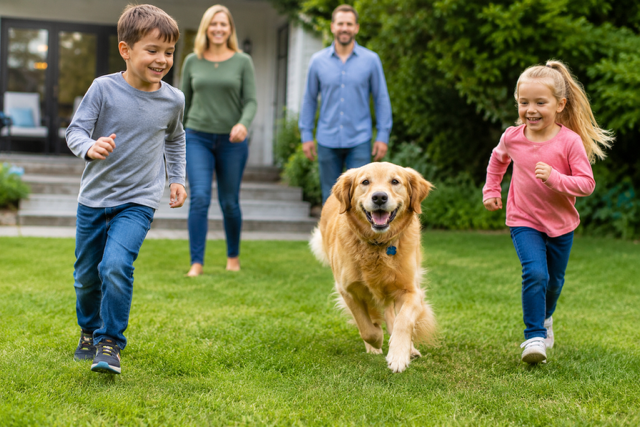
Here’s a number that stopped me in my tracks: 52 minutes. That’s how much extra physical activity young girls gained — every single day — simply by getting a family dog. Nearly a full hour. Not from a structured sport. Not from a new after-school program. Just from having a dog in the house.
If you’re raising kids and a dog under the same roof, you’re probably familiar with the chaos that comes with it — muddy paws, excited barking at dinner time, negotiations over who walks the dog tonight. But beneath all that glorious chaos, something remarkable is happening. Your dog and your kids are quietly pushing each other to be healthier. Scientists call it a feedback loop. We call it one of the best perks of life with dogs and kids.
In this post, we’re breaking down the science, naming the problem most families don’t see coming, and giving you a practical playbook to maximize the health benefits for your whole family — furry members included.
52 min
Extra physical activity gained by young girls — per day — after their family got a dog. Boys also saw significant increases in unstructured outdoor play.
Source: Adams et al., International Journal of Behavioral Nutrition and Physical Activity, 2024 (University of Western Australia / Telethon Kids Institute)
The Science: Your Dog Is a Better Fitness Coach Than You Think
Researchers at the Telethon Kids Institute and the University of Western Australia followed 600 children over three years — starting from preschool age — tracking their physical activity with accelerometers while also monitoring whether the family had a dog. The results were striking.
Lead researcher Emma Adams, a doctoral candidate at the university, put it plainly: “Adding a dog to the household increased young girls’ light intensity physical activity by 52 minutes a day — or almost an hour. It could make a meaningful difference to their health and wellbeing.”
But it wasn’t just girls. Both boys and girls who acquired a dog increased their unstructured physical activity — things like yard play, park trips, and dog walking — by around seven occasions per week compared to kids in families without dogs. Seven extra times a week they were outside, moving their bodies, because of the dog.
The flip side is equally telling: girls who lost their dog during the study saw their light-intensity physical activity drop by 62 minutes a day. The dog wasn’t just a bonus — the dog was the engine. You can read the full study here and the original press release from The Kids Research Institute Australia here.
“Girls who acquired a dog increased their unstructured physical activities by nearly seven occasions per week — going to the park, playing in the yard, walking the dog.”
— Emma Adams, Telethon Kids Institute & University of Western Australia, PLAYCE Cohort Study, 2024
This research builds on a 2025 randomized controlled trial published in the Journal of Public Health, which found that children who participated in dog-facilitated activity programs showed positive gains in social-emotional development as well — not just physical health. The benefits of growing up with a dog are stacking up fast in the scientific literature.
The Problem Nobody Warns You About: The Lazy Loop
Here’s where it gets interesting — and a little uncomfortable for dog parents.
The fitness loop works beautifully in one direction: an active dog encourages an active kid. But it also works in reverse. A sedentary dog leads to a sedentary kid, and a sedentary kid leads to an even more sedentary dog. We call this the Lazy Loop, and most families stumble into it without realizing it.
Think about the after-school grind: homework, screens, dinner, baths, bed. The dog gets a quick backyard bathroom break and calls it a day. The kids didn’t really move either. Tomorrow looks the same. Before long, the dog is sleeping 18 hours a day, and your kids’ after-school routine is completely screen-dominated — and you’ve unknowingly lost the fitness benefit your dog could be providing.
The good news? Once you see the loop, you can flip it.
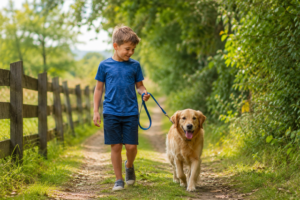
🔄 The Family Fitness Loop
How to Build the Virtuous Cycle Intentionally
The families who get the most out of this dynamic aren’t just lucky — they’ve built small habits that keep the loop spinning in the right direction. Here’s what works:
Let Kids Own the Walk
Assign a child (age 7+) as the “lead walker” for the day — with you alongside, but them holding the leash. Responsibility builds buy-in, and buy-in builds habit.
Set a Family Step Goal Together
Make it a household challenge: can the family collectively walk 2 miles today? Kids love a shared mission, and the dog becomes the mascot of the goal.
Replace One Screen Session with a “Dog Recess”
Instead of 30 minutes of TV after homework, make it 20 minutes of backyard fetch or a quick loop around the block. Dogs need decompression after alone-time too.
Schedule a Weekly “Dog Adventure”
A new trail, a different park, a pet-friendly beach day. Novel environments excite dogs and kids equally — and break the routine that leads to sedentary drift.
Teach Kids Canine Exercise Needs by Breed
A golden retriever needs very different activity from a bulldog. Make it a learning project — kids who understand their dog’s needs become the dog’s best advocates.
Track the Dog’s Rest, Not Just Activity
A well-exercised dog sleeps deeply and wakes refreshed and playful. Poor sleep in dogs (often from under-exercise) leads to restlessness, anxiety, and less inspiring play partners for your kids.
The Question Most Families Never Think to Ask: Is My Dog Actually Moving Enough?
Here’s a blind spot that catches families off guard. We track our kids’ activity — school PE minutes, soccer practice, weekend hikes. But we almost never systematically track our dog’s activity levels. And the dog is, as we now know, the engine of the whole system.
A dog who isn’t meeting their activity needs doesn’t just suffer physically — they become less fun to be around. They’re restless, sometimes destructive, sometimes anxious. They stop being the energetic invitation to go outside that drives your kids off the couch. The loop quietly breaks.
This is especially true as dogs age. What worked for a two-year-old lab doesn’t work for a seven-year-old one. Activity needs shift, and without any data, most families only notice the problem when behavioral issues appear — which is much harder to address than preventing it in the first place.
What does “enough” actually look like?
General guidelines suggest most adult dogs need 30 minutes to 2 hours of physical activity per day, depending heavily on breed, age, and health status. But those are wide ranges that don’t tell you much about your dog on this particular Tuesday. That’s where data changes everything.
The Bigger Picture: Why This Matters Right Now
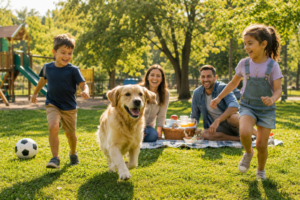
We’re in a cultural moment where families are actively trying to reclaim outdoor time. Parenting experts in 2026 are calling it the “analog turn” — a deliberate push away from screens and toward play-based, physically active childhoods. Dogs fit this movement perfectly. They are, at their core, an analog technology: they require presence, movement, and time. They don’t compete with a screen — they make a screen feel less necessary.
The data backs the trend: 76% of pet parents actively seek out products that can improve their pets’ health and wellness, and spending on pet wellness is rising year over year. Families aren’t just buying dogs — they’re investing in their dogs’ health as an extension of family health. That’s a meaningful shift.
Your dog is not a passive member of your household. They are an active, breathing, tail-wagging influence on how much your kids move, how much time your family spends outside, and how connected your children feel to the natural world. That influence can be maximized — or it can be squandered by default.
The loop is always running. The only question is which direction.
The Takeaway
The science is clear: families with dogs raise more active kids — especially daughters. The mechanism is the feedback loop between dog energy and child energy. When you keep your dog healthy, stimulated, and active, your kids follow. When that loop breaks — usually through busyness and default sedentary habits — everyone loses, including the dog.
The practical steps are simple: make kids stakeholders in the dog’s daily activity, build outdoor habits into the routine, swap one screen block for a dog recess, and use data to stay honest about whether your dog is actually getting what they need each day.
The family that moves together with their dog stays healthier together. And that’s not just a feel-good idea — it’s now peer-reviewed science.
Sources & Further Reading
- Adams, E.K., et al. (2024). Longitudinal effects of dog ownership, dog acquisition, and dog loss on children’s movement behaviours: findings from the PLAYCE cohort study. International Journal of Behavioral Nutrition and Physical Activity. Read the study →
- The Kids Research Institute Australia. (January 2024). Study finds link between family dog ownership and girls’ physical activity. Read the press release →
- Ng, M., et al. (2025). The impact of a dog-facilitated mobile physical activity intervention on children’s social–emotional development: a randomized controlled trial. Journal of Public Health. Read the study →
- NPR Health News. (February 2024). Kids who have dogs get an exercise boost, especially girls. Read the article →
- Dogtopia. (January 2026). Pet Care Industry Trends for 2026. Read the report →